Two days ago I published a benchmark showing that the open alternatives to Jev lose to a hardcoded “medium”. Jev routed 84.5% of 563 real prompts to the right model tier. Laya and Von, the open models, managed 61.6% at best.
Then we tried to buy Jev and couldn’t. TextCortex sells to European companies, and when we looked in September 2026 there was no EU deployment of Jev to buy. A router reads every prompt a customer types, so it has to run where the customer’s data is allowed to go.
So I took the model that lost and fine-tuned it. The result is Raya, a 300-million-parameter router that scores 81% on the same benchmark. It now runs in our production cluster on a CPU in Falkenstein, Germany, at 30 ms median latency, on a Hetzner server that costs €84 a month and was already on our bill.
The best router had no EU region, so we fine-tuned the one that lost.
Laya is an Apache-2.0 decision model: an mmBERT encoder with a small head that scores each option in a multiple-choice question. It speaks the same API as Jev. Out of the box it routed worse than a constant.
Two blind annotators, Claude Opus and Claude Sonnet, had labelled WildChat prompts with the same written rubric. Raya trains on their labels as soft targets, 50/50 where they disagreed, plus synthetic hard prompts in all 14 languages and some in-house routing data. The 563 test prompts come from WildChat shards that training never touched.
Training took about six minutes on one NVIDIA RTX A6000.
Six minutes on one GPU bought Laya 25 to 34 points.
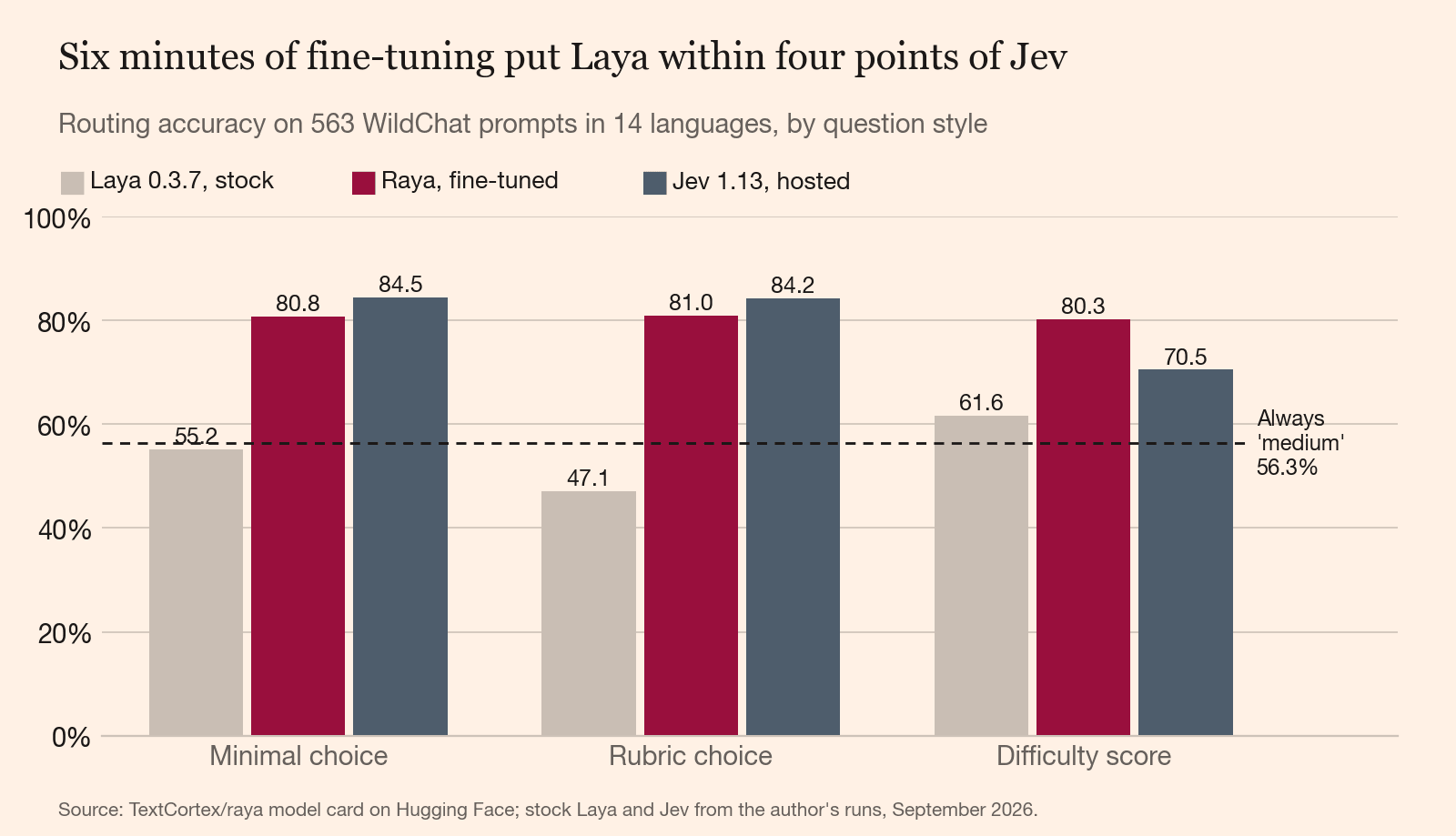
Raya scores 80 to 81% on all three question styles. On the difficulty score it beats Jev by ten points (80.3% against 70.5%, McNemar p < 0.001). On the two multiple-choice questions Jev is still ahead by three to four points. That gap is not significant at this sample size (p = 0.07 and 0.13), but it shows up on both, and I would bet on it being real.
Now the concession, and it is a big one. Raya learned from the same two annotators who wrote the gold labels. Jev never saw them. Some of Raya’s 81% is home advantage, and I cannot tell you how much. The annotators agree with each other only 78% of the time, so Raya has hit the ceiling of what these labels can measure.
Raya is also weakest where Jev is strongest. On the minimal question it scores 67% in Turkish against Jev’s 82%, and 76% in Portuguese against 90%. Like Jev, it sends only 7 of the 21 frontier prompts to frontier.
A 300M-parameter classifier has no business on a GPU.
Raya’s model card quotes 17 ms on a GPU. A whole GPU for one small forward pass per prompt is a lot of hardware, so I exported Raya to ONNX Runtime and tried five variants on two CPUs: an Intel i9-13900, which has VNNI int8 instructions, and an AMD EPYC 7502P, which does not.
| File | Size | Accuracy | i9-13900 p50 / p95 | EPYC 7502P p50 / p95 |
|---|---|---|---|---|
| fp32 | 1.23 GB | 81.2% | 38 / 297 ms | 60 / 487 ms |
| block-wise int8 | 0.89 GB | 81.5% | 34 / 282 ms | 127 / 975 ms |
| per-tensor int8 | 0.92 GB | 79.0% | 24 / 200 ms | not usable |
| PyTorch reference | 81.0% | 42 / 421 ms | 89 / 526 ms |
The fastest file loses two and a half points of accuracy, which in a router means real prompts sent to the wrong model. On the EPYC, per-tensor int8 overflowed and accuracy fell to between 54% and 80% depending on settings.
Block-wise int8 on the VNNI chip kept every point of accuracy. We ship that one. Sixteen threads were slower than eight on both CPUs, so each pod gets eight.
Moving to int8 on a VNNI CPU cut p95 from 1,066 ms to 228 ms.
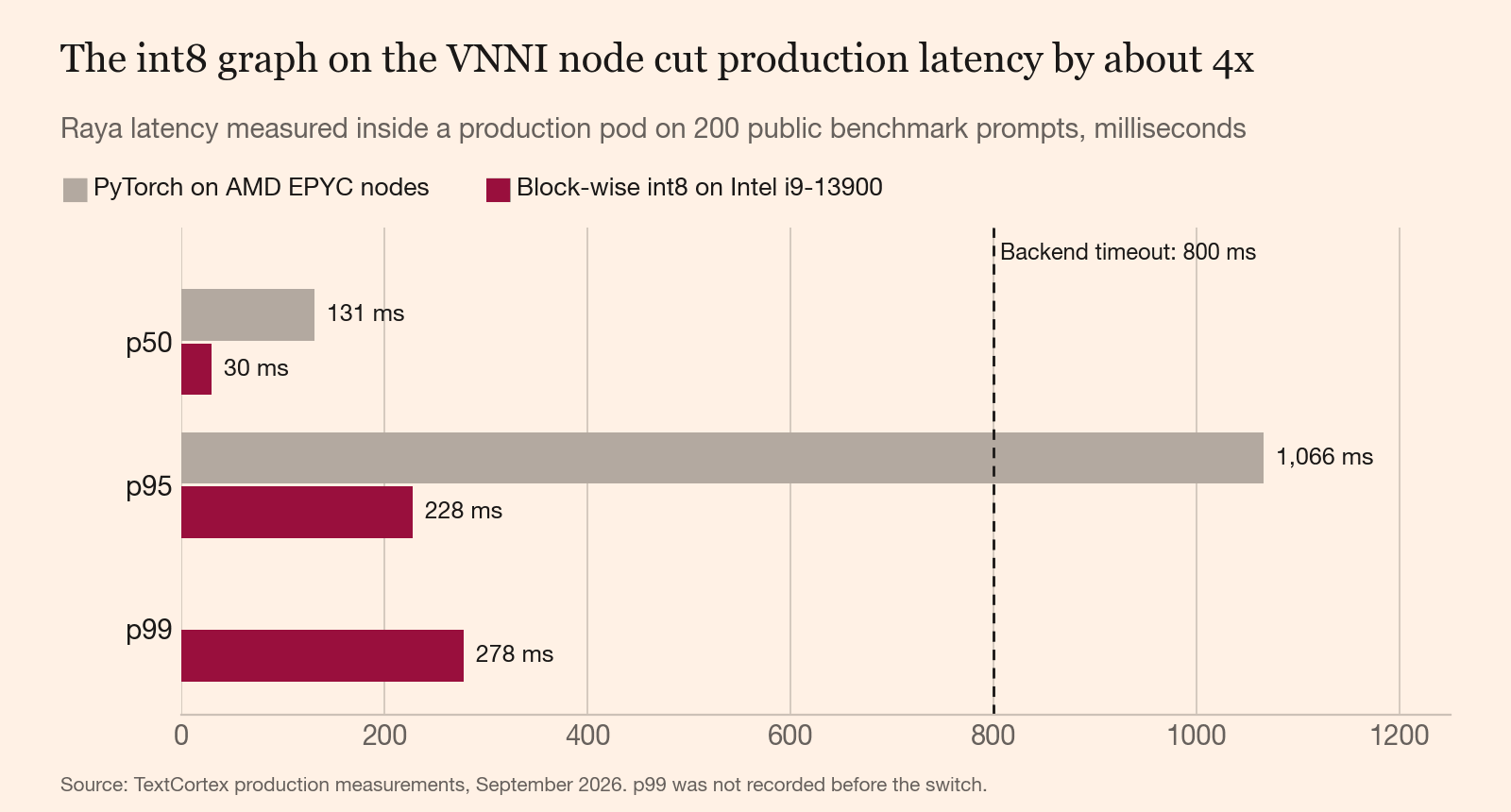
The first production deployment ran PyTorch on our EPYC nodes. Its p95 was 1,066 ms, above the 800 ms the backend waits before giving up on the router. More than one request in twenty would have timed out.
After the switch, measured inside a production pod: 30 ms p50, 228 ms p95, 278 ms p99. Each pod handles 16 to 18 requests a second, up from about 4. The image went from 4.0 GB to 1.0 GB. Accuracy on the benchmark is 81.5%, against 81.0% for the PyTorch original.
Int8 numerics depend on the CPU, so the image checks itself. The build verifies the model file’s SHA-256. Each pod refuses to start on a CPU without VNNI, and compares its answers with the PyTorch reference before it takes traffic.
The server costs €84 a month and was already on the bill.
Our cluster runs on Cloudfleet’s managed Kubernetes, with Hetzner dedicated servers as the nodes. Raya’s node has the same spec as Hetzner’s EX101: an i9-13900, 64 GB of ECC memory, two 1.92 TB NVMe drives. Hetzner lists it at €84 a month plus a €39 setup fee, before VAT (September 2026). Cloudfleet charges per vCPU on top, from €2.45 to €7.25 a month depending on plan.
We did not buy anything for Raya. The node was running other workloads at 22% of its CPU reserved. With Raya’s pods it is at 86%. The router cost us unused capacity on a machine we were already paying for.
The ceiling, as an estimate: two production pods handle about 32 requests a second, or roughly 83 million routing decisions in a 30-day month. Charge Raya for the whole server and that is about €1 per million decisions at full load, before VAT and Cloudfleet’s fee. At real traffic, the fixed €84 is what matters.
Everything rides on one server.
Only one node in our cluster has VNNI, so both production pods are pinned to it. If that server dies, the pods stay pending and Auto sends every prompt to medium. That is the constant router from the first post. Chat keeps working until the node is back.
The node is also full. At 86% reserved there is no room for a third pod, so going past about 32 requests a second means renting a second VNNI server. At eight simultaneous requests per pod, p95 climbs to about 1.2 seconds, past the 800 ms timeout, and the overflow falls back to medium. Today’s Auto traffic is nowhere near that.
And as I write this, no customer request reaches Raya. The smoke test routes all three tiers correctly in staging and production. The backend change that calls it is still in review.
An open model you fine-tune beats an open model you download.
Stock Laya lost to a constant. Six minutes of training on our own labels closed most of the gap to a hosted model, and a €84 CPU server closed the latency gap.
Jev is still better on the choice questions. It also has no EU deployment. For a European company, a router that is three points worse and runs in Falkenstein beats one that is better and runs somewhere we cannot send the prompt.
Raya is public under Apache-2.0, with the ONNX files, their checksums and the
raw benchmark results on its model card.
Run it on your own prompts against return "medium". If it cannot beat that
by ten points on your traffic, tell me, and I will publish that too.